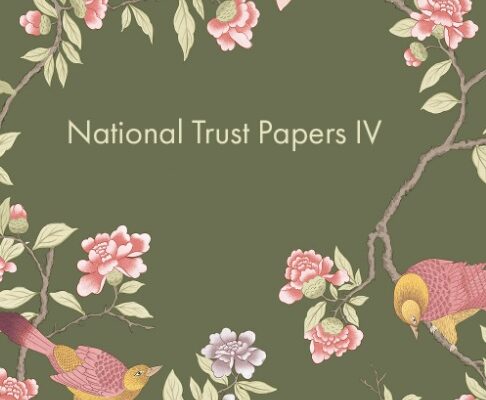
National Trust Papers IV features eight historic wallpaper designs that have been adapted and recoloured across 42 colourways for use within the modern home. Each design has been created for original patterns found at several of the National Trust’s historic houses, with the addition of one design that has been recoloured and revived from the Little Greene archive.
This versatile and eclectic collection comprises an array of exotic birds, stylised florals and scrolling trails alongside ditsy print florals and large-scale tropical murals.
National Trust Papers IV features eight historic wallpaper designs that have been adapted and recoloured across 42 colourways for use within the modern home. Each design has been created for original patterns found at several of the National Trust’s historic houses, with the addition of one design that has been recoloured and revived from the Little Greene archive.
This versatile and eclectic collection comprises an array of exotic birds, stylised florals and scrolling trails alongside ditsy print florals and large-scale tropical murals.
Aderyn – Erddig c. 1770
In the late 18th Century, Erddig in Wales was the family home of Philip Yorke and his wife Elizabeth. They would have selected this handpainted Chinese wallpaper, lavishly decorated with exquisite birds and flowers, for guests staying in the property’s State Bedroom. The original painting was delicate and keenly observed, with birds appearing in pairs; a subtle nod to the Chinese concept of the interconnectivity of opposites (yin and yang). The flowers seen here include magnolia (symbolising feminine beauty) and peony (symbolising eminence). Elements have been taken from the original to create a versatile and contemporary bird and floral trail, in five glorious colourways.

Capricorn – Early 19th century
This mural is inspired by sections of historic early 19th century panels by Velay and Zuber, and has been repainted by hand to reflect idealised and stereotypical depictions of landscapes that were considered at the time to be ‘romantic’ or ‘exotic’. This contemporary reproduction features luscious landscapes incorporating monkeys and tropical birds across three panels. Produced in one neutral and three colourful variations, this paper is designed to bring dynamism and interest to any interior. Supplied in a standard 10m roll, there are three drops, each (up to a maximum of) 3.25m in height, which hang in sequence and can be repeated around the room.

Bamboo Floral – Kingston Lacy Estate c. 1790
This design has been based on small painted sections of Chinese wallpaper found at Kingston Lacy Estate in Dorset. Little is known about these fragments, of which around 200 have been identified, and it is unclear whether the print was actually used in the house itself. Imported Chinese wallpapers were hugely popular in 19th century manor houses, and the paper hangers would have cut out individual elements and pasted them on top of the panels, to give the wallpaper its panoramic flow. It’s quite possible these fragments were left over from that process. Reshaped into a repeating pattern for the modern interior, this design has been surface-printed and produced in five fresh colourways, with a contemporary pop of colour on each.

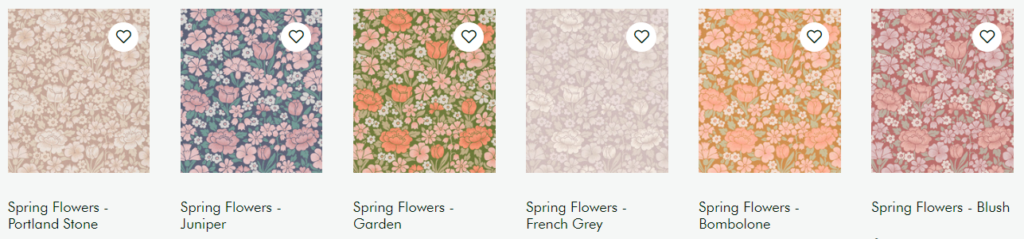
Spring Flowers – Standen House c. 1910
Standen House in West Sussex is one of the country’s finest examples of an Arts & Crafts house, designed by Philip Webb with interiors by William Morris. This small floral design, featuring an array of spring flowers, is typical of the way designers of the period were inspired by flowers and foliage and how they stylised these forms to bring nature inside. The surviving piece of this paper is in a monochromatic colourway of blue and white, but otherwise little is known about the history of this specific design. Now coloured in six differing ways, it is offered in two gentle neutrals and on four stronger grounds.
Great Ormond Street c.1890 (From the Little Greene Archive)
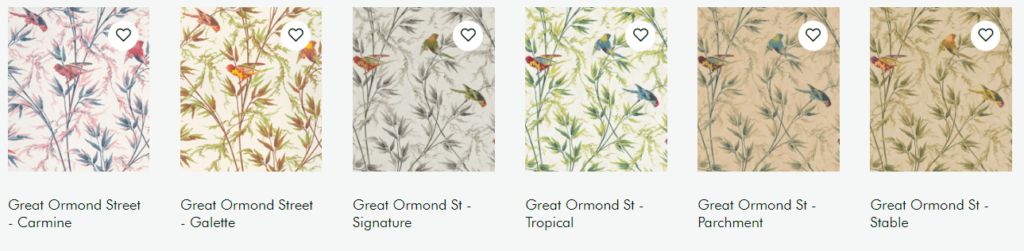
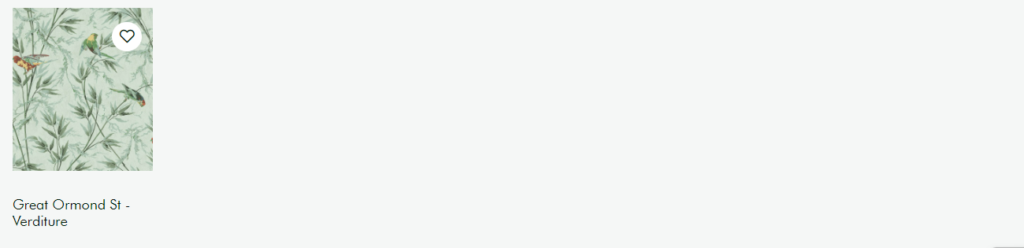
Recoloured and revived from the Little Greene archive, this colourful parrot motif is closely based on one of a multi-layered group of papers removed from the ground floor rear closet of a very early-18th century terrace house opposite Great Ormond Street Children’s Hospital. This design was subsequently machine-made on cellulose paper in the late 19th century. Available in seven, surface-printed colourways.
Burges Butterfly – Knightshayes Court, Devon c. 1878
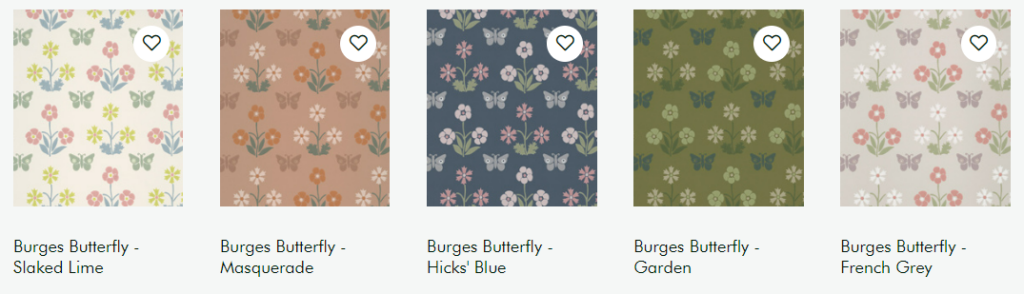
Adorning the walls of the Boudoir at Knightshayes Court in Devon, ‘Burges Butterfly’ was designed by Gothic Revival architect and designer William Burges (1827-1881) and is an obvious relation to another wallpaper of the same origin, ‘Burges Snail’. Just like the Snail, the design has no deeper historic association with Knightshayes Court, Burges’s only complete country house, but is another Burges pattern, influenced by his passion for the architecture and art of medieval Europe and Asian-influenced design. This fun, charming paper has been faithfully reproduced in five contemporary, surface-printed colourways.
Mosaic Trail – Felbrigg Hall c. 1885
An elegant, floral trail with sophisticated tonal variation – little is known about the history of this paper, but it is likely to originate from the Aesthetic movement in the late 19th Century. The pattern replicates a tiled mosaic, achieving a charming, informal finish with subtle shading effects. The design has been reproduced to reflect the original in four smart, graduated colourways, surface printed to replicate the mosaic effect and to enhance the texture and tonal variation of the colours.

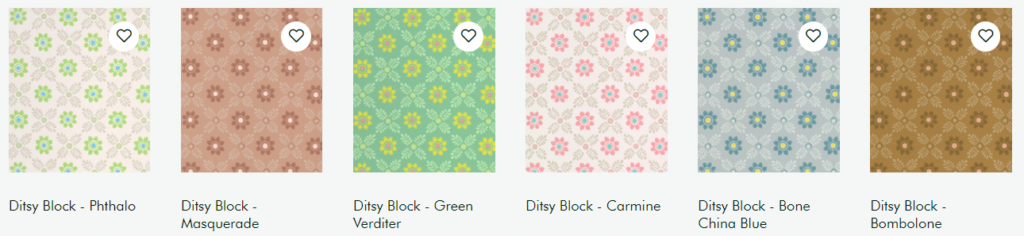
Ditsy Block – Felbrigg Hall c. 1900
Found at Felbrigg Hall in Norfolk, this attractive floral lattice is one of the most interesting wallpapers at the property. Its location arouses curiosity, as the wallpaper is from an attic room believed to be a former staff room – an unusual location to hang an ornate wallpaper at the time. The paper is likely to have been woodblock-printed and the original also features painted ‘braiding’ at the top of the design, mimicking of damask furnishings. Produced in six contemporary colourways, this design has been surface-printed to authentically reflect its original manufacturing method.